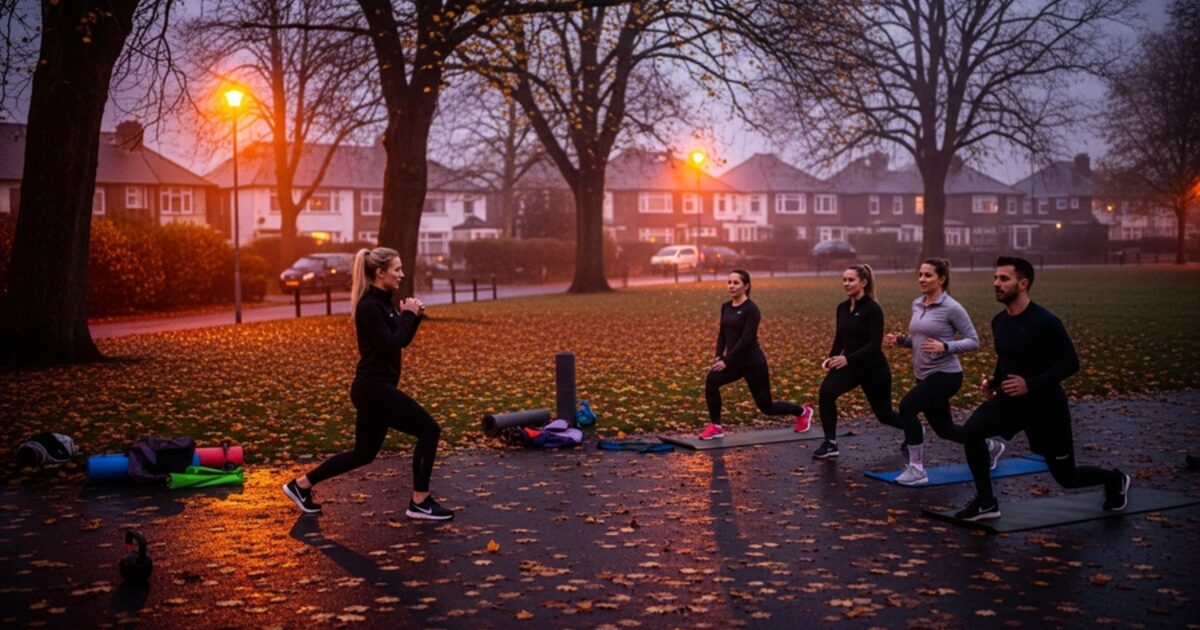
Keep the appointment; change the setting
When a workday finishes after sunset, a routine built entirely around outdoor exercise becomes harder to follow. Rain, fallen leaves and an unlit route can all change what feels practical. The answer is not necessarily a tougher programme: it is a plan with fewer decisions to make.
For people in Sale, Altrincham and the surrounding areas, a useful autumn routine combines two strength sessions with regular moderate activity. Decide when you will train, what you will do and what replaces it if the weather turns. That gives you a workable alternative before you are tired or short of time.
This guide focuses on maintaining a routine through autumn. If you are returning after a long break, start with the gradual return-to-exercise guide instead of attempting the whole week immediately.
A weather-flexible weekly autumn fitness plan
The example below includes 150 minutes of moderate aerobic activity plus two separate strength sessions. Strength work does not automatically count towards your aerobic total. For moderate activity, use the NHS talk test: you should be able to talk, but not sing.
If you currently do very little exercise, shorten these sessions and build up gradually. The table is an example to adapt, not a personalised prescription or a target you must reach in your first week.
| Day | Planned session | Wet-weather option |
|---|---|---|
| Monday | Strength A, 20–30 minutes | Use the indoor strength session below; no outdoor backup needed. |
| Tuesday | 30 minutes of brisk walking | Try 3 × 10 minutes of indoor marching or low-impact dancing. |
| Wednesday | 30 minutes of moderate cardio | Use a stationary bike if available, or a low-impact indoor workout. |
| Thursday | Strength B, 20–30 minutes | Repeat the strength session, adjusting exercises to your ability. |
| Friday | 30 minutes of brisk walking | Take a daylight break; switch to indoor cardio if surfaces are unsafe. |
| Saturday | 40 minutes of moderate activity | Choose an indoor session or split it into two 20-minute sessions. |
| Sunday | 20 minutes of moderate activity | Finish with indoor dancing, cycling or marching; plan next week. |
Put these appointments in your diary alongside your commute, school run or lunch break. If Monday and Thursday do not work, choose two other days with recovery time between them. Consistency matters more than the names of the days.
A simple indoor strength session for autumn
Start with around five minutes of comfortable movement: walk around the room, march gently and move your shoulders through a comfortable range. Clear the floor, wear suitable footwear and use a stable chair against a wall. Avoid slippery socks or unsecured equipment.
Choose versions of these movements that feel controlled and appropriate to you. Begin with one set; if comfortable, build towards two sets of 6–12 repetitions, resting between sets. Stop before your technique deteriorates.
- Chair squat or sit-to-stand: stand up from a stable chair and sit down slowly. Use a higher seat or light hand support if needed.
- Wall press-up: place your hands on a wall and lower your chest towards it with control. Move closer to the wall to make it easier.
- Hip hinge: practise moving your hips back with softly bent knees, keeping the movement comfortable. Learn the pattern before adding resistance.
- Resistance-band row: if you have suitable equipment and know how to use it safely, draw your elbows back without shrugging. Follow the manufacturer’s instructions; do not improvise a door attachment.
- Standing calf raise: hold a stable support and rise onto your toes, then lower slowly.
- Wall plank: rest your forearms against a wall and keep your body comfortably aligned for a short hold, breathing normally.
For your second session, repeat the movements rather than changing everything. Progress one factor at a time: an extra repetition, a second set or modestly more resistance. If you do not have pulling equipment, a trainer can help you choose a safe alternative rather than leaving that movement out indefinitely.
Health note: speak to your GP before starting if you have not exercised for some time or have medical conditions or concerns. Seek appropriate help for chest pain, dizziness, unusual breathlessness or a new injury. This article is general guidance, not treatment or rehabilitation advice.
Make daylight walking your first outdoor option
A familiar route near home or work can be easier to repeat than a special trip. Try a daylight lunch-break walk in Sale or Altrincham when your schedule allows. Local parks and paths can be useful, but check access, conditions and lighting before you leave; do not assume a route is suitable after dark.
- Wear footwear with appropriate grip and watch for wet leaves, puddles and uneven surfaces.
- Choose well-lit, familiar routes when daylight is unavailable, with reflective or visible clothing.
- Avoid isolated or unlit waterside paths after dark, and do not train outdoors in unsafe conditions.
- Switch indoors when visibility, surfaces or weather make the session unsuitable.
For ideas to research in daylight, see the local outdoor workout guide. For a deeper discussion of evening routines, read the existing dark-evenings fitness guide.
Use a shorter fallback on a busy week
A fallback is a smaller version of your session, not a punishment for missing the original. If a 30-minute appointment disappears, keep ten minutes for a brisk walk or a brief strength practice. Short bouts of activity count, even if that week falls below your longer-term target.
At the end of the week, review what actually happened. Did the wet-weather option work? Was your planned time realistic? Would you be more consistent before work, at lunch or with an appointment at a studio? Change the practical obstacle rather than adding more goals.
Support the routine with simple recovery habits
Keep regular meals, include protein-containing foods and fruit or vegetables, and drink regularly around exercise. There is no need for an “autumn detox” or a crash diet. Aim for a consistent sleep routine and leave recovery time between challenging strength sessions.
Measure progress by sessions completed, exercise feeling easier and the resistance or repetitions you can manage with good technique. Do not expect a guaranteed body transformation by a particular date.
Need a routine that fits your autumn schedule?
DC Personal Trainer offers one-to-one coaching at a private studio in Sale and mobile sessions in the local area. Discuss your starting point, the space you have and the appointments you can realistically keep.
Explore personal training in Sale · Personal training for Altrincham residents · Home training in Altrincham
Discuss your autumn fitness planAutumn fitness: common questions
How often should I exercise in autumn?
The NHS advises adults aged 19 to 64 to aim for at least 150 minutes of moderate activity or 75 minutes of vigorous activity a week, plus strengthening activities on at least two days. Build towards this gradually if you are currently inactive; autumn does not require a different target.
What can I do instead of an outdoor workout when it rains?
Keep the same appointment in your diary and change the setting. For cardio, try indoor marching, low-impact dancing or a stationary bike. For strength, use controlled chair squats, wall press-ups and a suitable resistance-band row. Choose movements and intensity appropriate to your fitness and available space.
Can short workouts still help me stay fit?
Yes. Short bouts of activity contribute to your weekly total, and a manageable session is often easier to repeat. A ten-minute walk or brief strength session is useful, but it is not automatically a replacement for the full weekly activity and strengthening recommendations.
Can I have personal training at home in Sale or Altrincham?
DC Personal Trainer offers mobile personal training in Sale and Altrincham, as well as sessions at a private studio in Sale. Contact the trainer to discuss your goals, space, equipment needs and current availability.
Source and further reading
Activity targets and the moderate-intensity talk test are based on the NHS physical activity guidelines for adults aged 19 to 64. Older adults and people with individual health needs may need additional or adapted guidance.
Published 6 October 2026. The weekly schedule and workout examples are practical suggestions, not a substitute for individual assessment.
Browse more fitness guides